 Sprinkler Age A Publication of the American Fire Sprinkler Association
AFSA Members Donate, Install Sprinkler and Fire Alarm Systems
The Fire Museum of Maryland in Lutherville is one of the largest fire museums showcasing the history of firefighting in America. It grew from the Heaver family’s private collection of more than 40 years. Previously unprotected, this important and comprehensive museum is finally safe from the ravages of fire, thanks to the American Fire Sprinkler Association’s (AFSA) Chesapeake Bay Chapter, where members came together and helped install sprinkler systems.
Chesapeake Bay Chapter Executive Director Danielle Fowler has loved and visited the museum for over two decades. “I remember taking my kids here when they were little—and now they’re grown! It’s just a wonderful place full of fascinating history and equipment. It must be protected and shared with our community and future generations.”
COMING TOGETHER FOR A GREAT CAUSE
The project began when Marty Smith, SET, CFPS, president & CEO, ATS Advisors, LLC, learned about the museum and its needs. About 10 years ago, the museum asked the company for help with a new fire alarm system. Smith and his brother Jeff owned Alarm Tech Solutions, LLC at the time. “I toured the museum, and it was filled with so many interesting artifacts. Being a fire alarm guy more than a sprinkler guy, I loved the fire alarm office!”
Marty and his brother, Jeff, designed the fire alarm and emergency communication systems for the museum. Because it wasn’t protected by sprinklers, they worked with Gamewell-FCI to donate the equipment and had one of Alarm Tech’s electrical contractor customers, Freestate Electric, install a fire alarm, with complete area smoke detection, and a speaker-based emergency communication system.
“It was tricky working around all of those artifacts,” remembers Smith. “We got lifts donated because of the elaborate collection of fire trucks and other large items that you have to work around and on top of that can’t be moved.”
As that project was nearing completion, Smith was asked to serve on the museum’s board. One of the first projects he decided to take on was a much needed sprinkler system since the museum was not protected. He had the initial design done but then sold their business.
That’s when Smith connected with AFSA’s Chesapeake Bay Chapter and briefly talked about the project at one of its meetings. “Before I even sat down from presenting the project, I had two emails from vendors offering to help,” he remembers.
“Our chapter members are always looking to give back to our community and not just be members of it,” says Fowler. “We held a chapter meeting at the museum so everyone could see what the project was all about and that all of these amazing artifacts weren’t protected. That really lit a fire to get them more involved. I don’t think there was one naysayer in the group. Everyone was on board!”
Tim Parham, from Everon (formerly ADT Commercial), Columbia, Md., volunteered to spearhead the project. “All of the materials and installation were donated by AFSA member companies, including JCI, Strickland Fire Protection and Absolute Fire Protection, both a part of Pye-Barker Fire & Safety and Castle Sprinkler & Alarm. AFSA was huge in getting the community involved.”
Parham notes. “Kevin Galligan from JCI did the design, and his field team did the install in the annex, including the riser. They also did riser installation in the east wing/addition to the main building, and up to the office space.”
The museum comprises two buildings; the largest one is the main space, housing a large exhibit hall, function rooms, archives, and offices. A second building is a four-bay garage used for storage called the “annex.”
“We were required to sprinkler both buildings,” comments Smith. “We put a wet system in both and a preaction system in the mezzanine level of the main building for the archives and library. We replaced the existing air sampling smoke detection system with a new air sampling smoke detection system that is a part of the preaction system to replace the obsolete system.”
AFSA’s Vice President of Engineering and Technical Services, John August Denhardt, P.E, FSFPE, was the liaison between the museum and Baltimore County to help move things along.
The new systems were the star of a Donor Celebration Luncheon held December 3, 2024. Steve Heaver, co-founder, executive director, and curator of the museum held guided tours and attendees were able to also explore the exhibits on their own. Mission BBQ donated a hearty and delicious lunch.
“I really appreciate everyone coming together for their help and support. The luncheon was fun and the perfect setting to celebrate this great accomplishment together,” comments Fowler.
Chapter Chair Jason Martin agrees. “The dedication that Steve Heaver and his team put into the Fire Museum of Maryland to tell the stories of how fire protection improved since the 18th century, and preserve the machines that kept us safe, is just magnificent. When it was brought to our attention the museum needed a sprinkler system to protect the history of the fire service, our chapter members jumped right in to make it happen.”
“Throughout the project, it was a showing of sprinkler competitors working together to complete a quality job that protects this history for future generations to enjoy,” Martin notes. “As the Chapter Chair, I have such a great appreciation for our AFSA Chesapeake Bay Chapter members who made this project happen!”
LEARNING ABOUT FIRE HISTORY MUSEUM
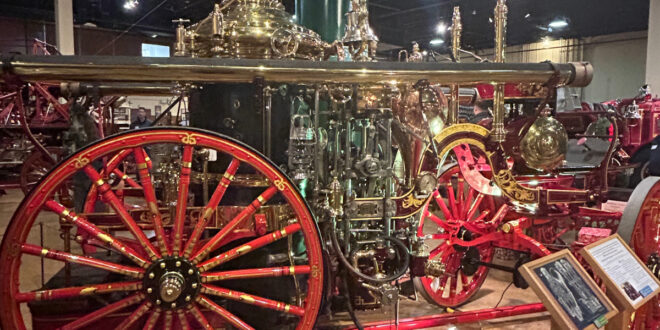
The museum, founded in 1971, is a leading institution in preserving, restoring, and interpreting the history of the urban fire service in the United States. It is open to the public and houses a world-class collection of historic hand engines, horse-drawn, steam-powered, and motorized vehicles. Exhibits include firefighting tools, antique toys, the Great Baltimore Fire of 1904, a working fire alarm office, a cast-iron building facade from Baltimore’s Engine Co. #8 built in 1871, and a children’s discovery room. The museum features curriculum-based educational tours in science, history, and technology. It also participates in community events, hosts an annual steam show, and rents out meeting space and vehicles.
Heaver, who has led the museum for many years, recently moved to a curator and director emeritus role. Jeff Buchheit has joined the museum as its new director. Others on staff include Tom Miller, assistant curator; Aaron Lippincott, educator; and Amy Landsman, public relations. Nate Davis is responsible for facilities, Lee Smith handles mechanical projects, and Ed Burgee oversees collection maintenance.
The museum’s apparatus on exhibit ranges from 1806 to the present. Many of its restored apparatus are working road vehicles. The crown jewels in its firefighting history are an 1856 Agnew hand engine, an 1899 American steam engine, a 1905 Hale water tower, a 1918 Mack ‘Bulldog’ ladder truck, a 1913 Ahrens-Fox model A pumping engine—the only one left in the world, and a 1947 Mack Floodlight Wagon. In 2024, the museum welcomed more than 15,500 guests, its second-highest attendance to date.
COMMITMENT TO THE COMMUNITY
Now protected, the Fire Museum of Maryland continues to educate the public and increase awareness of firefighting and the fire protection industry. Future plans for the museum include displaying the east wing risers behind plexiglass instead of drywall so the public can see them and learn more about the sprinkler system.
“Thanks to so many generous people and so many generous companies, we now see the project through to completion,” summarizes Smith. “We really appreciate having worked with so many wonderful people and companies to get the sprinkler, fire alarm, and emergency communications systems added to help protect the history of this great industry.”
The museum is never resting on its laurels to acquire, refurbish, and display new items, including a fire boat currently being renovated. Chapter members are also not done helping the museum. “We are also working to raise the last bit of funds to offset the $9,500 that the museum has paid out-of-pocket for $250,000 worth of equipment,” states Smith. Anyone wishing to donate can reach out to Museum Director Jeff Buchheit or visit the museum’s donation webpage at museumfiremuseummd.org/donate.
“When someone needs something and we have the ability to help, we’re there,” comments Fowler. “This was a fantastic endeavor for our chapter to get involved with, and I encourage other chapters to seek out similar projects in their area.”
For more information about the Chesapeake Bay Chapter, its projects, and events, visit afsachesapeakechapter.org or contact Fowler via email at daniellef@pottersignal.com.
The Fire Museum of Maryland is open on Saturdays year ‘round and Wednesday-Friday in June, July, and August. Group tours and special events can be arranged. Have an item, picture, or document that you would like to donate to the museum? Email details and pictures to collections@FireMuseumMD.org.
The museum depends on individual donors and corporate sponsors for new projects and exhibits, operational costs, and other ongoing events. It receives funding from Baltimore County, donors, members, planned giving, admissions, and visitors. For more information on the museum and to donate, visit firemuseummd.org.