 Sprinkler Age A Publication of the American Fire Sprinkler Association
This blog contains sponsored content.
Short Descriptor: NFPA 25 doesn’t have to be complicated. Learn how to assess your sprinkler system’s testing and replacement needs with a straightforward, environment-based workflow.
NFPA research shows that properly working sprinklers dramatically reduce property damage and improve the chance of safe evacuation. Yet many facility managers and AHJs struggle to translate NFPA 25 into a clear, structured compliance plan. The key is to approach testing and replacement as a repeatable workflow rather than an isolated event.
In practice, that means defining sample areas, understanding how harsh environments accelerate degradation, and knowing which sprinklers can safely stay in service longer. With guidance from NFPA Global Solutions, Facility Managers, ITM providers, Authorities Having Jurisdiction, and Fire Sprinkler Contractors can better understand how to manage the requirements of NFPA 25.
The steps below serve as a practical field guide to help you determine where your system stands, and what needs to happen next.
Note: This guide is intended to complement NFPA 25, not replace it. Always reference the most current edition.
Step 1: Confirm the environment and corrosion risk
NFPA 25 requires you to treat different environments as different sample areas because corrosion and contamination don’t affect every space the same way. Start by classifying each area of your building as “harsh” or “not harsh,” then map which sprinklers serve each environment.
Harsh environments include places like paper mills, packing houses, tanneries, alkali plants, fertilizer facilities, foundries, steam rooms, salt storage rooms, and locations exposed to outdoor weather or corrosive vapors. Even within a single property, you might have mild office spaces next to highly corrosive loading docks or battery rooms.
This environmental step matters because NFPA 25 requires much shorter intervals for sprinklers in harsh areas, especially if they are not listed as corrosion resistant. Corrosion-resistant sprinklers use special materials or coatings to slow degradation, allowing longer testing/replacement timelines while still maintaining safety margins.
In your workflow, create a simple table: list each area, note whether it is harsh, and record how many sprinklers are installed there. This makes it easier to define sample areas and prevents accidentally applying a 50-year interval to a sprinkler head sitting in a steam room or exposed driveway.
Step 2: Identify sprinkler type, age, and O-ring seals
Once you understand the environment, evaluate the sprinklers themselves. It is important to perform a thorough visual inspection before removing any sprinklers for sampling. As outlined in NFPA 25 (2026 Edition), Section 5.2.1.1.1, any sprinkler exhibiting visible corrosion, paint, mechanical damage, or detrimental signs of loading should be replaced immediately, regardless of its age.
Then, document the sprinkler type and whether any sprinklers use O-ring water seals. O-ring designs have shown failure rates greater than 50%. For this reason, NFPA Global Solutions recommends proactively replacing O-ring sprinklers once they are identified, even though this is not a direct NFPA 25 requirement. This proactive move can significantly cut administrative burden and retesting costs over time. However, NFPA Global Solutions can still test O-ring sprinklers if a laboratory report is needed before replacement – a high failure rate would likely result in a failing test report for these sprinklers.
Finally, verify the installation date. The NFPA 25 timelines differ for early suppression fast response (ESFR), control mode specific application (CMSA), dry sprinklers, fast response sprinklers, and all other standard response sprinklers. A 20-year-old dry sprinkler in a freezer has very different obligations than a 7-year-old corrosion-resistant head in a swimming pool area. Accurate age data is essential before you move to the next step of the workflow.
Step 3: Apply NFPA 25 initial testing or replacement intervals
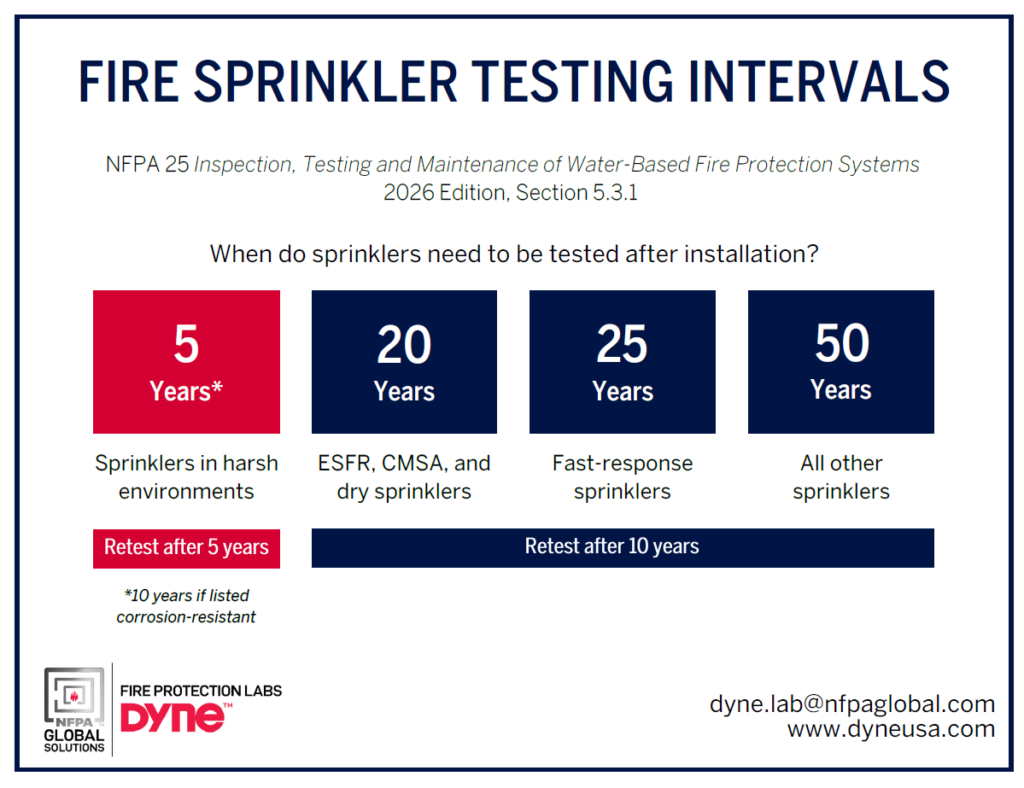
With environment, type, and age documented, apply the initial NFPA 25 intervals from the 2026 edition, section 5.3.1. These intervals tell you when sprinklers must first be tested or replaced after installation.
The illustration below provides a clear visual reference for these NFPA 25 timelines:
NFPA 25 allows you to either replace sprinklers outright or submit a field sample for lab testing, generally at least four sprinklers or 1% of the sprinklers in each defined sample area, chosen at random. A representative sample must include at least one of every sprinkler type and one from each type of environment within that area.
If even one sprinkler fails the test, NFPA 25 requires all sprinklers represented by that sample set in the area to be replaced.
Step 4: Set up the correct retesting schedule
If your first round of testing shows that sampled sprinklers are acceptable, the sprinklers in those designated sample areas can remain in service. However, NFPA 25 still requires follow-up testing or replacement at defined intervals based on age and environment. These recurring intervals—shown in the illustration above—are what turn testing into an ongoing maintenance cycle rather than a one-time event.
To keep this manageable, create a testing calendar or computerized maintenance management system (CMMS) schedule that tracks each sample area’s next due date.
One additional rule to note: any sprinkler that has reached 75 years of age must be retested or replaced on a 5-year cycle going forward, regardless of environment or sprinkler type. Flag these in your CMMS separately so they don’t get grouped under a standard 10-year retest schedule by mistake.
Grouping similar areas (for example, all 25-year-old fast-response office sprinklers) can reduce mobilization costs for ITM contractors and make it easier to budget for future testing or replacements.
When documenting your retesting plan, always note the specific NFPA 25 edition incorporated by reference in your jurisdiction and maintain records of lab reports, replacement invoices, and visual inspections for review by AHJs and insurers.
Practical tips to avoid failures, recalls, and surprises
Beyond following NFPA 25, a few practical actions can reduce risk and cost. First, conduct thorough visual inspections before pulling sample heads for testing. Obvious corrosion, paint, mechanical damage, or loading should trigger replacement regardless of age, as emphasized in NFPA 25 2026 Edition Section 5.2.1.1.1.
Second, monitor manufacturer advisories and recall notices for specific sprinkler models to stay proactive and replace recalled sprinklers if necessary.
Third, collaborate with your ITM contractor and AHJ to define sample areas so they are meaningful and practical. Very large, mixed-use spaces might benefit from being split into several areas so that a single failed head does not trigger massive, unplanned replacement.
Finally, if your review shows uncertainty around age, harshness of the environment, or sprinkler type, default to the shorter testing interval and keep a record of why that decision was made. That diligence can reduce liability exposure while giving you confidence that if a fire occurs, your system is ready to perform quickly, reliably, and effectively.
Connect with NFPA Global Solutions at AFSA45!
If you’re attending AFSA45, we invite you to connect with the NFPA Global Solutions team to learn how we can support your testing and maintenance needs.
As a full-service NFPA 25 testing laboratory, we provide fast and accurate testing to help you stay compliant and confident in your system performance. We’re also excited to announce that we are expanding our capabilities with new services, including corrosion & microbiologically influenced corrosion (MIC), diesel fuel, and water mist nozzle testing.
Stop by booth #711 to learn more about our 5-business-day turnaround times, free sample kits and shipping, demo the Dropmaster DM25, and how we can partner with you for your fire protection needs.
Join us at our AFSA45 sessions:
- Sunday, September 27th | 3:00 PM – 4:30 PM | Grand Oaks D-F: “To Compliance & Beyond: Aligning NFPA 1300 & NFPA 25”
- Tuesday, September 29th | 8:00 AM – 9:00 AM | Grand Oaks A-C: “Antifreeze Testing: Listed & Legacy Solutions”
- Tuesday, September 29th | 9:15 AM – 10:15 AM | Grand Oaks A-C: “NFPA 25 Sprinkler Testing”