 Sprinkler Age A Publication of the American Fire Sprinkler Association
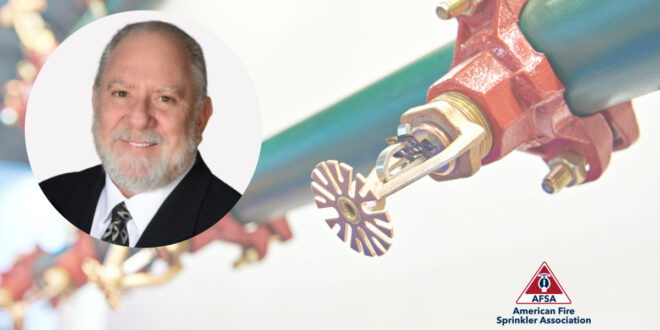
Let me begin with a sincere THANK YOU to everyone who helped make AFSA44, our annual convention just a few short months ago, a monumental success. Once again, we enjoyed a record turnout of attendees and exhibitors, and we look forward to seeing everyone in San Antonio, Texas, for AFSA45. Please mark your calendars for September 27-30, 2026. Leave the suits and ties at home because this will be strictly a jeans and boots event!
As we ring in the new year, most of us will start with a few resolutions and a personal mental bookmark. One that marks the end of one year and the promises we make to ourselves about things we might do differently in the next. We’re drawn to wonder about what might interfere with our plans for ourselves and our businesses. There is no shortage of prognosticators willing to opine on what 2026 will look like in terms of the economy or anything else, including the end of the world as we know it (AI will put us all out of work and computers will take over the world—run for the hills!).
Well, I don’t think AI will put us all out of a job in 2026, although I do believe it will change the way many of us work, particularly how we research topics or perform repetitive functions. While I don’t think AI will replace many jobs in our industry, I do believe people who embrace and understand how to utilize AI tools to become more efficient will be more likely to keep the jobs we have. If computers do start to take over the planet, pull the plug and wait for the battery backup to die. We should all be just fine.
While the U.S. economy and our industry have been performing well for a long time now, I don’t think 2026 will be the year we see the bubble burst. No, I don’t have a crystal ball, and I have been wrong before (today). Still, I have faith that politicians and our government leaders will do everything possible to ensure economic stability as we head into the midterm elections. In 1992, James Carville (a member of the Clinton administration) said, “It’s the economy, stupid,” and I think that’s still true today. That isn’t to say our industry won’t face challenges in terms of economic issues related to construction market shifts, more so on a regional basis than in the national picture. While there has been a significant push from industry toward recurring revenue streams, at its core, the fire sprinkler industry remains closely tied to the construction industry for many of our members.
Residential construction is expected to remain strong, particularly in the Sun Belt states, primarily due to migration patterns and continued housing shortages. Pro tip for those first-time homebuyers, we understand that purchasing a new home may be a better deal than buying an older one, partly due to the discounts offered by new home builders. That aside, when we examine the markets and what work might still be available, it appears that residential, specifically high-density residential construction, will remain strong in many regions. Tenant improvement work largely depends on the available inventory of unused space in your area. Many companies have moved past the remote work scenario and have reoccupied pre-COVID workspaces. That said, many people continue to work from home efficiently and effectively, which has a significant impact on predicting the need for new office space.
The big demand in the new construction sector looks to be the energy sector, with plans for energy generation facilities on the rise to meet the increasing demands of an AI-driven world. We see Meta building facilities in small to medium rural communities where land is less expensive and there are available job seekers. Others are doing the same, which is exciting to see. However, these large projects tend to favor larger subcontractors who can provide manpower and have the necessary bonding capacity, so they may not offer backlog opportunities to some members. With an aging U.S. population, hospitals and healthcare facilities are expected to continue seeing growth in both new and remodeling projects. Additionally, numerous tall buildings across America still require retrofitting with fire sprinklers.
Regardless of the region or market segment, ITM work will always remain strong, if for no other reason than the fact that codes and standards require all systems to be inspected, tested, and maintained, even in unoccupied buildings or spaces. Enforcement has gained popularity everywhere, partly due to the use of third-party reporting systems.
Now, I am no expert in the field of economics, nor am I qualified to evaluate where the world or the U.S. will be this time next year. The war in Ukraine, tariffs, elections, and a host of other daily headlines may undoubtedly have a greater impact on the markets than anything I can predict. Still, I know this industry has been kind to all of us through good and bad times, economic swings, and even through the COVID-19 pandemic. So, I remain optimistic that 2026 will be an excellent year for us all, and especially for AFSA members as we continue to expand and grow our services, training, and educational offerings in response to market demands and member requests. We are in the process of adding a training facility for low voltage (fire alarms) and special hazards, including kitchen hood systems, eLight testing, fire door inspections, and fire suppression systems ITM. Our expanded training facility is expected to be operational by Q4 of 2026, with a series of dry-run seminars and initial class registrations scheduled for early 2027. Our goal is to help our members expand their service offerings with the same level of expertise as you perform on wet systems today. We will provide more updates on this as we progress closer to making this project a reality.
I wish everyone a prosperous 2026 and beyond!
ABOUT THE AUTHOR: Bob Caputo, CFPS, is president of AFSA. He has been an important part of the fire sprinkler industry for over 41 years and is a long-time member of AFSA and promoter of merit shop contracting. He has chaired and served on many NFPA committees. Caputo has written and presented seminars throughout the world on fire protection and life-safety systems and is a regular speaker at AFSA and NFPA conventions. He has developed AFSA education and training materials and chaired two chapters of AFSA—Arizona and Southern California. Caputo is the recipient of numerous awards, including Fire Protection Contractor magazine’s “Industry Person of the Year,” San Diego County Fire Chiefs’ Association’s “Fire Prevention Officer of the Year,” and AFSA’s highest honor, the Henry S. Parmelee Award.