 Sprinkler Age A Publication of the American Fire Sprinkler Association
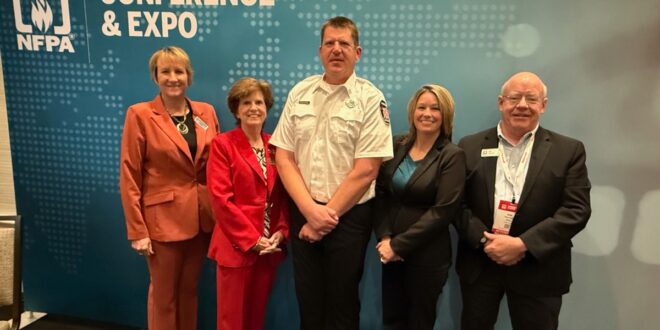
Panel of Experienced Local Advocates Share Proven Strategies
One- and two-family homes present the greatest fire risk to residents and responding firefighters. Home fires can become deadly in as little as two minutes because of modern construction methods, synthetic materials and furnishings and emerging technology, such as the increasing use of lithium-ion batteries. Home fire sprinklers are the only technology that stop a fire from becoming deadly.
For years now, national NFPA and ICC codes have required sprinklers in all new one- and two-family homes. Unfortunately, that life-saving sprinkler requirement is readily being removed from local codes across the country. Powerful lobbying efforts and misinformation from the home building industry, coupled with claims that installing sprinklers is too costly are driving this anti-code strategy.
One reason their anti-code strategy works is that local decision makers don’t understand the bigger, longer-term picture for their constituents: what is the cost of not protecting new homes? Removing sprinklers from the codes encourages substandard homes to be built.
Decision makers need to consider that when fire strikes these unsprinklered homes there can be significant consequences. The real cost of a fire in a home that’s not protected with fire sprinklers far outweighs the cost of installing home fire sprinklers. The real costs could include death, injury, displacement and property damage. There is also a community impact on firefighter health and safety and fire department resources.
The result? Every new home built without fire sprinklers threatens Community Risk Reduction (CRR) for decades.
Battling back with education and information is the solution. This past June, a strategic response to the challenge was presented at the NFPA Conference and Expo. The Home Fire Sprinkler Coalition conducted a panel discussion titled “Proven Strategies to Help Decision Makers Choose Home Fire Sprinklers.” Each panelist highlighted successful approaches used in their communities that resulted in entire developments being protected. Key in this approach was offering developer incentives and strategies that prevented sprinklers from being omitted when codes were being updated.
FROM DEVELOPER INCENTIVES TO PASSING THE REQUIREMENT
Kevin Bergstrom, deputy fire marshal, Camas Washougal Fire Department, talked about how the home fire sprinkler requirement failed in his jurisdiction because of strong opposition from builders in 2003. The city council did support negotiating incentives working with developers. He said it was important to meet with all stakeholders early in the planning stage, including planners, developers, city officials and real estate professionals. The incentives included higher density, single-access points, increased hydrant spacing and other trade ups. Camas also offered infrastructure flexibility, waived fees and allowed flow through passage purge systems to eliminate backflow valves. Bergstrom said over time, developers appreciated the benefits of incentives and recognized the added marketing value of their new homes being protected with fire sprinklers.
After 13 years of offering incentives, Camas passed the requirement and continued to offer the incentives. Bergstrom said 98% of all new homes are now protected. Most important, there have been five documented sprinkler saves. Two were cooking fires; the others were an electrical fire, a spray combustion fire and a lithium-ion battery fire. The average cost to install fire sprinklers is $1.85/sprinklered ft2 This year, Camas is celebrating a total of 5,000 homes protected with sprinklers.
Neighboring Washougal also passed the requirement two years after Camas did. To view a short video about Camas protecting 5,000 homes, visit youtube.com/watch?v=MIrekK-6Wko.
HOW WORKING WITH BUILDER GROUPS LED TO SUPPORTING LAS VEGAS HOME FIRE SPRINKLER REQUIREMENT
Bob Sullivan, NFPA regional director, talked about how Las Vegas, Nev., one of the top housing markets in the country, worked with the local home builder association to identify and resolve concerns about a home fire sprinkler requirement. He said the builder association had valid concerns that could potentially slow down the development process, including plan reviews, permits, field inspections, water tap and supply line sizing issues and any other extras added to NFPA 13D or P2904 requirements. Other builder topics included trade ups to reduce costs, such as reductions in water supply requirements, narrower streets or allowing sidewalks on one side of the street.
A Nevada statute required any governing body considering a residential sprinkler mandate in new construction less than 5,000 ft2 to perform a cost-benefit analysis. In 2017, the University of Nevada, Las Vegas, was commissioned by the City of Las Vegas Fire Department to perform such an analysis. The objective study determined there was a definite cost-benefit to homeowners and home builders. The UNLV report played an important role in the Las Vegas City Council passing the requirement, as did resolution of home builder association opposition. The ordinance took effect in 2019 as part of the 2018 International Codes. To date, more than 18,000 new homes have been built in Las Vegas with home fire sprinklers. The average cost to install home fire sprinklers is $.95/sprinklered ft2.
THE PITFALLS OF AN ORDINANCE PASSAGE BEFORE ALL STAKEHOLDERS ARE INFORMED
The good news is an ordinance was passed; the bad news was the community wasn’t ready for it when it did. This could happen anywhere so Brittany Brown, chief of fire prevention, Leawood (Kan.) Fire Department, talked about the challenges she faced after a fire sprinkler requirement was passed in Commerce City, Colo. before all stakeholders had been informed or involved.
At the time, she was the division chief of prevention for the South Adams County Fire Department. She said the requirement was passed without enough planning, leaving too many questions that should have been answered before the requirement. There was a lack of standardized guidance, and the initial requirement passed as a P2904 only. It was later changed to all system types. This led to frustrated builders as installation was not meeting timelines and legal issues held up construction. Other questions included water line and meter size, backflow inclusion, how to achieve hydraulic calculations, which agency was doing plan review and who was collecting fees.
Chief Brown talked about her response to this challenge. The fire department worked to educate stakeholders with cost benefit analyses, how-to information and joint training. They conducted live burn demonstrations, including a live burn using a full-scale house. During this event, the homebuilders association was invited and more than 150 people attended to see these concepts in action. She said it was important to sell life-safety as a concept well enough to get the community to invest in their own self-preservation and truly see how fire sprinklers in homes are part of that.
The common theme from each panelist is the importance of information and strategic planning. HFSC has resources to help any community achieve these key objectives. Free tools help educate decision makers about why all new homes need to be protected with home fire sprinklers. The new HFSC online Community Impact Tool makes it easy for users to input their local data and information and create custom-made, actionable insights for use in presentations to decision makers. This tool and other resources support the proven strategies discussed during the panel presentations. Protecting all new homes is often a grassroots issue with many challenges. Plan for that and turn to HFSC for its wealth of free resources to support the fire service as they advocate for home fire sprinklers. For more information, visit homefiresprinkler.org.

ABOUT THE AUTHOR: Peg Paul is the founder/president of Peg Paul & Associates (PPA), a marketing communications firm that specializes in fire and life safety education and awareness programs. Paul has been the communications manager for HFSC since 1997, where she oversees the development and implementation of educational programs for members of the fire service, local officials, consumers, home building industry, real estate and insurance agents, water purveyors, and other targeted groups. Paul and her team have secured more than $10 million in Federal and corporate foundation grants. Paul serves on the board of the NFPA Research Foundation and the IAFC Life Safety Section. She served on the Phoenix Society for Burn Survivors board for 10 years. In 2023, Paul received the CFSI/IFSTA Dr. Anne W. Phillips Award for Leadership in Fire Safety Education. She was named AFSA’s 2014 Fire Sprinkler Advocate of the Year.