 Sprinkler Age A Publication of the American Fire Sprinkler Association
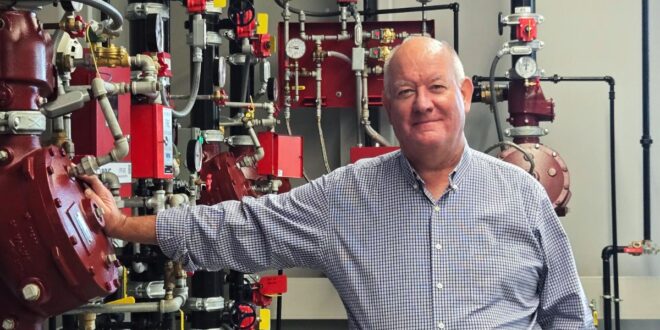
Martin Workman Receives AFSA’s Henry S. Parmelee Award
“Leading by example” is often touted yet not always accomplished. Hallmarks of this leadership style include acting with integrity, demonstrating accountability, fostering trust, and modeling best work ethics and values. Leaders who embody these traits inspire others to achieve their best. One member of the fire protection industry who lives this principle is Martin Workman, senior vice president of product development for The Viking Corporation, Inc. Because of his commitment and dedication to education, training, and the betterment of the industry, the American Fire Sprinkler Association (AFSA) is pleased to recognize Workman with its highest honor, the Henry S. Parmelee Award.
TRAINING FOR THE INDUSTRY
Workman joined the fire protection industry when a friend’s father offered him a job in western Michigan, if “he didn’t mind getting dirty.” Workman was working at an auto parts store and was happy to accept, as he was paying his way through college. “I didn’t really understand what I was doing at first,” he remembers. “I unloaded pipe mostly.”
Workman was on a prevailing wage job, and his new boss wanted him to join the company’s apprentice program. Workman agreed and quickly advanced through the trade. “As a second-year apprentice, I was running jobs,” Workman remembers. He eventually left the field to pursue design, but spent most of his time in contracting at Peninsula Fire Protection in Grand Rapids, Mich. In 1994, Workman was named vice president and part owner.
Workman was also involved with training at Peninsula. One night, he filled in for the regular instructor on the design and hydraulics section. “That one night turned into five years,” he laughs. Workman found he had a knack for teaching and connecting with the apprentices and began instructing for all levels of the program.
That same year, AFSA and Associated Builders and Contractors (ABC) agreed to establish AFSA’s Training for Excellence correspondence courses as the national standard for sprinkler fitter apprenticeship training. Ken Huber at ABC asked Workman if he’d be a Subject Matter Expert (SME) on the committee. “I initially said no because I didn’t consider myself an expert,” says Workman. “I’d never even heard of the term ‘Subject Matter Expert!’”
However, Huber convinced Workman that his input would be valuable. “The day I flew into D.C. for my first set of meetings, I was clueless!” Workman recalls. “I am so grateful to the people I met there— Danielle Dixon, Lenny Hollis, Janet Knowles, Bob McCullough, John McDonald, Doug Rice, Manning Strickland, Jack Viola—all are very special to me, and I know there are others I am forgetting to mention. They were outstanding mentors who taught me much about business, the trade, and people.”
Viola was impressed with Workman’s work and dedication to the project. “Not only did Martin generously share his expertise, but he also single-handedly wrote critical chapters that have become foundational to the program’s continued success. His willingness to go above and beyond for the rewrite committee was evident throughout every phase of the project.”
Those meetings were long and intensive. “It was all about being together and working,” comments Workman. Weekends away from home were required because most committee members were business owners who had to return to their companies. Workman soaked up all the knowledge he could. “Being from Michigan and not having traveled much, it was fascinating to learn what was required for the different regions around the country, like minimum bury for underground pipe due to freezing.”
“Jack, Bob, and Manning were very welcoming to me as a young guy,” says Workman. “After I met Bob, he would ask me why Peninsula wasn’t a member of AFSA. I told him we did our own thing in Michigan. He then paid for my wife, Tracy, and me to attend the convention and see what AFSA was all about.”
He continues, “Bob was so committed to the training of the industry. He had a true passion for it. I was lucky to understand that early on. The more you gave of yourself or to the trade, the more you’d see it come back. Bob would say, ‘The better you train your people, the better you train your competition, and that’s good for business.’ He was good that way.”
Peninsula joined AFSA as a contractor member, and the combined training debuted thanks to the committee’s dedication and unselfish energy. Eventually, ABC’s craft training curriculum spun off into a new independent non-profit organization, the National Center for Construction Education and Research (NCCER). AFSA’s partnership with NCCER continues today, providing the industry with best-in-class apprenticeship training.
Retired AFSA staff member Janet Knowles, AFSA’s communications director at the time, served as AFSA’s staff liaison to the review committee and worked closely with the SMEs throughout the four-book revision. “Martin committed a significant investment in time and always came prepared and was willing to step up when needed,” she says. “Although I retired from AFSA nearly a decade ago, I still like to look through Sprinkler Age magazine online. When I see an article written by Martin or a note that he will be speaking at an upcoming convention, I know that he is still delivering on his promises to further the goals of the fire sprinkler industry and AFSA.”
Viola agrees. “Martin’s unwavering commitment to the writing and upgrading of the curriculum has been instrumental in raising the standards for fire sprinkler apprentices nationwide. His tireless efforts and deep knowledge have helped ensure that AFSA’s curriculum remains the benchmark for excellence in the field.”
Workman takes the principles of mentorship and giving back to heart. It’s been the foundation for all he’s done on both the contractor and manufacturer/supplier sides of the industry. “The people I talked about who mentored me while we were developing apprenticeship training didn’t charge me for it, and I have the responsibility to do the same. People have always given to me. I’ve advanced my career because of it and been able to do many things other people haven’t. These guys were teaching me a craft. Very few people aren’t willing to teach you everything they know, and they do it willingly in this industry. You lead by example. And the examples I’m giving you are true leaders.”
Workman has also written for the United Association’s (UA) apprentice curriculum and judged its apprentice program. “Training is training,” he says.
GIVING BACK TO THE INDUSTRY
Working on the national apprentice training committee was Workman’s first introduction to AFSA and the start of a decades-long relationship. After attending that first convention in Atlanta in 1996, Workman joined and became involved in many of AFSA’s projects and initiatives.
Workman served as a judge for several National Apprentice Competitions (NAC). When AFSA established its scholarship essay contest to educate the public and high school students about sprinkler systems and the industry, Workman volunteered to serve as a judge for several years. That required him to read many batches of essays written by students. “I enjoyed reading the essays. I was surprised by how many there were. Workman comments. “It was gratifying to see the attention the trade was getting from young people.”
Workman was invited to represent AFSA on the NFPA 30, Flammable and Combustible Liquids Code, committee in the late 1990s. That led to serving on numerous committees, including NFPA 30b, Code for the Manufacture and Storage of Aerosol Products; NFPA 13, Standard for the Installation of Sprinkler Systems; NFPA 11, Standard for the Low-, Medium, and High Expansion Foam; NFPA 401, Standard on Aircraft Hangars; NFPA 415, Standard on Airport Terminal Buildings, Fueling Ramp Drainage, and Loading Walkways; NFPA 423 Standard for Construction and Protection of Aircraft Engine Test Facilities; NFPA 502, Standard for Road Tunnels, Bridges, and Other Limited Access Highways. He has served as a principal member on all the committees except for NFPA 502, where he is an alternate member.
Workman also served on AFSA’s Technical Advisory Council (TAC), which was established to address technical issues and NFPA codes and standards related to the fire sprinkler industry. Forty contractors, designers, and engineers from around the country served on the TAC during this time, comprised of AFSA representatives on NFPA technical committees, sprinkler manufacturers from AFSA’s Manufacturers/Suppliers (M/S) Council, and AFSA staff.
“It’s impressive to see such a large contractor presence in the TAC, says Workman. The members are very committed to their craft and profession,” says Workman.
Workman is also a member of the National Fire Protection Association (NFPA), National Fire Sprinkler Association (NFSA), and Society for Fire Protection Engineers (SFPE). He has served as a presenter, author, and trainer for ABC, AFSA, and NCCER. Workman is NICET Level II Special Hazards and Level III Sprinkler Layout certified and is considered an SME for NCCER.
“Martin has been a staunch advocate for fire sprinkler systems. His involvement with industry associations demonstrates his commitment to advancing life safety systems,” comments James Golinveaux, chairman of the board for The Viking Group. “Through his participation with NFPA, he actively contributes to the development and refinement of fire protection standards, ensuring they meet the highest safety and efficiency criteria.”
DEVELOPING PRODUCTS FOR THE INDUSTRY
Peninsula Fire Protection was a customer of Mike Bosma’s at Viking, and in the mid-90s, that relationship changed the trajectory of Workman’s path in the industry. “He asked if I’d ever be interested in working for Viking, but I was happy at Peninsula,” Workman remembers. “By 1997, though, I was ready for a change.”
Bosma, currently president of Viking SupplyNet, notes that Workman always had a real passion for the business. “I felt we needed someone with that contractor perspective, and we’ve benefited greatly from Martin’s passion for the industry, customer service, and training. Many of our products today have his fingerprints all over them, especially on the valve and special hazards side. He was instrumental in developing dry ESFRs, new versions of dry valves, and integrated systems.”
When Workman started at Viking, he created many training presentations covering wet, dry, deluge, special hazard, and preaction systems. “We had to create all that curriculum,” Workman notes. “Traveling globally, you’re leaving those presentations about good fire protection everywhere,” Workman notes. “Viking has a long history of commitment to training. Dick Groos taught our very first training program!”
One of Workman’s tasks was to travel with the salespeople to meet customers and bring back feedback. From that first trip out of Michigan to Washington, D.C., Workman has now traveled the globe—throughout North and South America, Europe, Asia, the Middle East, Australia, New Zealand, South Africa—and was able to see how the installation of fire sprinklers differed from the U.S.
Going on sales calls to customers and sharing information were highlights from those days. “If you have a great idea, it’s nice, but if no one else likes it, it doesn’t work,” Workman notes.
He says those sales calls were where he saw his efforts pay off. “As I’ve traveled the world, I’ve been able to share trade experience with others. Viking has often been asked for assistance, and we’ve been able to contribute to many country and global standards. I’m lucky to be at a company supporting that willingness to help. It’s hard when you’re at other companies that don’t see value in training and volunteering.”
Workman rose to product manager at Viking, overseeing its entire product line. One of his responsibilities was chairing an internal New Product Development (NPD) group, which identifies new products and prioritizes projects for research and development. In 2010, Workman rose to vice president of product management, which recognized his role in product management and new product development for Viking. He continued to chair the new product development team and manage the Viking product line, and became instrumental in setting up and managing its non-water-based system products. He was also a significant factor in the continued development of the Viking seminar and numerous training efforts within the company and the sprinkler industry.
In March 2021, Workman was promoted to senior vice president, product experience, where he continues to develop products, business, digital initiatives, special hazard sales, training, and technical services for Viking. He also continues his involvement with research and development, manufacturing, and marketing to develop products for the industry.
All his roles at Viking have required Workman to travel extended periods away from home and family. He was on the road for many years, and then COVID hit. “We all stopped traveling for a while, but it happened at a good time when I needed to be home,” Workman says.
FOCUSING ON FAMILY
Family is extremely important to Workman. His wife, Tracy, has been by his side from the beginning, always supportive and just as committed to the industry and its people. “I remember when I was still fitting pipe, and I had some work release individuals working on a job. I shared my lunch with some of them when we broke for lunch because they had nothing. I was telling Tracy about it that night. The next day, I opened my Igloo, and she had also made lunch for them. From then on, she made lunches for all those men who worked for me.”
Tracy was also instrumental when Workman was developing the national apprenticeship training materials. “I’d have the dining room table covered in papers and books,” Workman remembers. “If Tracy came in and read what I’d written and could understand it, then I knew the apprentices would, too,” Workman remembers. “If she came with me to a trade show, she would help man the booth. She knows what I’m talking about because she’s been involved with this industry right along with me.”
The couple had four children along the way—Jessica, Martin II, Emily, and Kaleigh—and Workman gives Tracy all the credit for raising them while he constantly traveled. “I wasn’t home a lot of nights, and she’s made a lot of sacrifices for me. I really appreciate her and the kids for all they’ve done.”
The Workmans’ children have grown up and had families of their own. Daughter Jessica has three children, Jacob, Emilia, and Lucas; son Martin II and wife Candance have one daughter, June; daughter Emily and her husband Gredual have three children, Oliver, Lydia, and Emma; and daughter Kaleigh and her husband Francisco (Frankie) also have three children, Frank Martin and Edison.
Tracy was initially diagnosed with cancer in 2015. After surgery, it appeared she was good. In 2017, she was diagnosed with cancer again and is undergoing various treatments. In 2024, Tracy was diagnosed with chemotherapy-induced leukemia in 2024. “I seriously thought about retiring when Tracy battled that first bout of cancer, and she said I’d drive her and myself crazy if I did,” Workman remembers with a smile. “Our children have been wonderfully supportive, and her doctors are great,” comments Workman. “Cancer really changes your perspective,” he notes, “but we’re going on 39 years together, ready for our 40th, and pushing towards our 50th!”
The couple currently resides in the country outside of Delton, Mich. Workman isn’t planning to retire anytime soon, but is setting that up for the long term. “It’s always time to move on at some point,” he notes. “I’ve thoroughly enjoyed being involved in the fire protection industry, but I’m looking forward to more time with Tracy, the kids, and grandkids.”
LOOKING TOWARDS THE FUTURE
What are Workman’s thoughts on the future of the sprinkler industry? We’re behind. “Industry always seems to be 20 years ahead of product development in fire sprinklers. What we once knew in storage is now changing at a fast pace, and the standards are having a hard time keeping up with it. We will soon have warehouses without aisles, and maybe no people. Automated retrieval storage racks and robotic top-loading and side-loading storage are here today. At the moment, NFPA 13 has to say these facilities are out of its scope.”
Boat storage is one example. Workman notes that Michigan has more lakes than any other state, and boat storage abounds and has been built with sprinkler protection. Yet NFPA 13 doesn’t cover that.
“Going forward, we will see more dependence and reliance on manufacturers for testing,” Workman notes. “Customers don’t listen to us like they used to. We’ll say, ‘Don’t use plastic,’ and they say, ‘That’s what we use.’ ‘Don’t store with automatic retrieval systems,’ and they say, ‘Well, that’s how we store.’”
He continues. “The future is exciting to me because of new technology and new needs,” Workman says. “We’ve disproved what we thought we knew from much of the storage testing we did decades ago. I can see us going back to doing more in-rack sprinklers with a smaller K-Factor because you need them in more spaces. There are definitely some challenges for the industry, and they always come from the contractors. Oftentimes, they are plowing the new trail. ‘Sprinkler per 13’ is the norm, but when it’s out of scope, you get involved with insurance and local Authorities Having Jurisdiction (AHJs).”
Workman sees the residential area as the biggest growth market, with the most significant opportunity. “That’s where I think we run into the people problem—not enough of them to fulfill the public’s safety needs. Most people end up here accidentally, and a few are born into the trade. The trade found me, yet I didn’t know I was lost!”
Workman sees recruitment as a continuing challenge for this industry. “How do we make the trade interesting? I don’t think people really understand that this industry is not a place you end up; it’s a launch pad.”
To that end, Workman and Viking work with the AFSA Virginia Chapter in its recruitment efforts. During the chapter’s annual career fair, Brian Berkley with Viking travels down with virtual-reality (VR) headsets that introduce the industry in a gaming-type experience for students. “It gives the upcoming generation a taste of the trade and lets them know about our great opportunities,” comments Workman. “I’m a perfect example of how far someone can go in this industry. I started at $3.50 an hour and didn’t know much of anything. This trade rewards you if you have an above-average work ethic.”
Workman is calling for industry professionals to get involved. “The more we can promote our trade, the better, because it’s such a positive one. I always tell people that the result of what I do saves lives and property. We install sprinklers in buildings according to a prescriptive code, which means it’s been tested and approved.”
He continues. “I also want to really encourage everyone to participate in the NFPA process. So many think it’s an old boys’ club, and it’s not. Anyone can submit a change, and it must be read. All Underwriters Laboratories’ standards are also consensus documents,” he notes. “If you don’t like something, you want to contribute. Simply reach out to someone, and they’ll help you. The entire trade is full of people who want to enable each other. Once you submit a public input, the organization must tell you what they did with it.”
RECOGNIZING DEDICATION
In 1983, AFSA created its highest honor, the Henry S. Parmelee Award, to recognize an outstanding individual who has dedicated himself or herself to the fire sprinkler industry and the goal of fire safety through automatic sprinklers. AFSA will present this year’s award to Workman during AFSA44: Convention, Exhibition, and Apprentice Competition, to be held Oct. 15-18 at the Gaylord National in Washington, D.C. The presentation will be the highlight of the general session on Friday, Oct. 17.
“Martin embodies the essence of the Parmelee Award,” says Golinveaux. “His leadership within The Viking Corporation and the broader fire protection industry, relentless advocacy for fire sprinkler systems, and unwavering dedication to education and training make him a worthy recipient of this prestigious honor. Martin’s contributions have not only advanced protection technology and standards but have also inspired and educated the next generation of professionals dedicated to fire safety.”
“This year, we had a great group of nominations. When it came to Martin’s bio, involvement with AFSA, his commitment to training, and glowing recommendations from James Golinveaux [past award recipient] and Janet Knowles, one of my mentors when I joined the Board, he was an excellent choice!” comments AFSA Chair of the Board Linda Biernacki, president of Fire Tech Systems, Inc., Shreveport, La. “I am so pleased that we will honor his accomplishments in front of his peers at our 44th annual convention at the Gaylord National. Congratulations, Martin!”
Steve Rians, RME, SET, vice president of sales for AFPG, College Station, Texas, is a colleague and friend of Workman. “One beautiful gift of the fire protection industry is the numerous friendships that are developed, some for life. Martin and I have enjoyed such a friendship. It was mostly me, picking that beautiful mind for challenging solutions to difficult problems,” he notes. “Beyond our mutual affection for ‘The King of Beers,’ I have been allowed to support and offer prayers and love to Martin as he has stood up tall, facing the health challenges of his beloved wife, Tracy. It’s nothing short of a miracle, and we continue to pray for her healing. All our conversations include much joy and laughter, which is a testimony to the strength of one Martin Workman. I couldn’t think of a more deserving individual to receive such an honor as the Parmelee Award. God Speed, Martin!”
“During my 47 years working in this industry, I have met three types of people: people with a job, people with a career, and people who share a passion for fire and life safety that drives them to love this industry in ways that consistently exceed our expectations. This year’s recipient of the AFSA Henry S. Parmelee award, Martin Workman, exemplifies the values and dedication to selfless service, whose passion for this industry is always immediately evident,” comments AFSA President Bob Caputo, CFPS. “Martin seems to have the time to share his vast knowledge and experience about products, technology, and fire safety systems with anyone who asks. This is a well-deserved recognition for a man who has always been the quiet professional.”
“Martin is our savant from the field perspective and is probably the best example of a pure sprinkler guy,” notes Bosma. “He can talk in practical terms that everyone can understand and has a passion that’s unrivaled. He’s invaluable to us at Viking, and we’re happy to see him receive this recognition.”
“Martin has been recognized with the prestigious Parmelee Award in celebration of his outstanding dedication and impact on AFSA’s apprenticeship program,” Viola comments. “Congratulations, Martin, on this well-deserved honor, and thank you for your invaluable contributions!”
“Receiving this award definitely blows me away,” Workman says. “I look at the industry icons who have received it. Oddly, you don’t put yourself in that space even though you know most of them. There are some outstanding individuals who have committed themselves to the trade, each in their own way. What’s most touching to me is to be recognized by some of the people who have meant a lot to me. Some of them I never got to tell them that, and I wish I had.”
“Leading by example has always touched me. I’m so willing to help because so many helped me, so why wouldn’t I share it with others?”
EDITOR’S NOTE: Do you know someone who should be nominated for AFSA’s highest honor, the Henry S. Parmelee Award? AFSA is proud to recognize those individuals who have dedicated themselves to the professional advancement of the fire sprinkler industry and to the goal of fire safety through automatic sprinklers.
Click here for a list of past recipients and to nominate someone for this award year-round. (Member login required.)